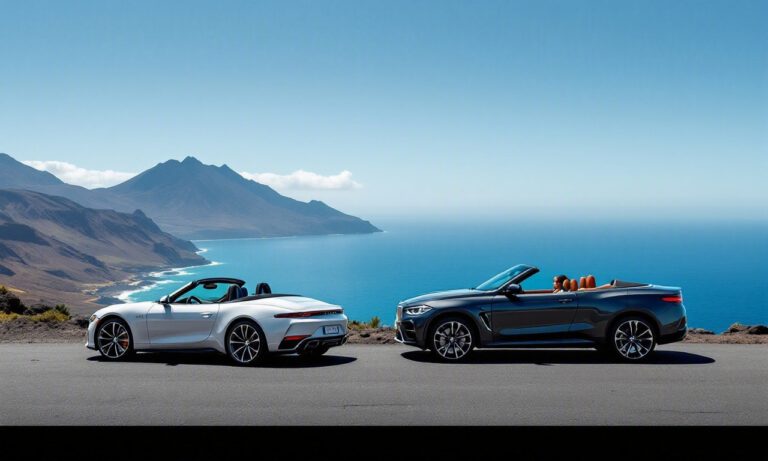
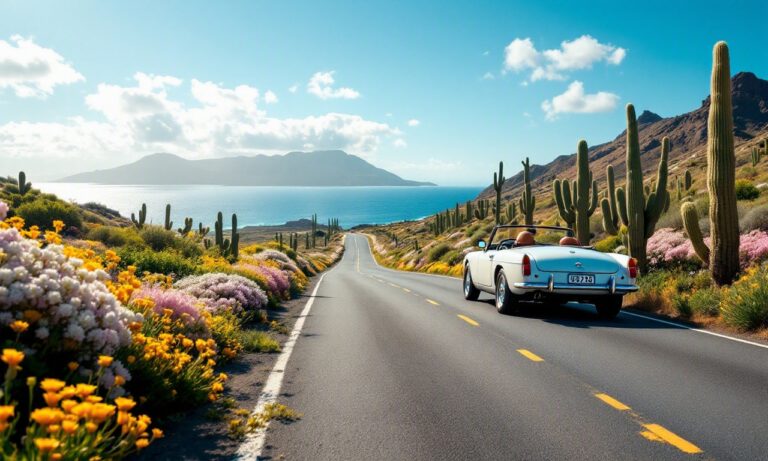
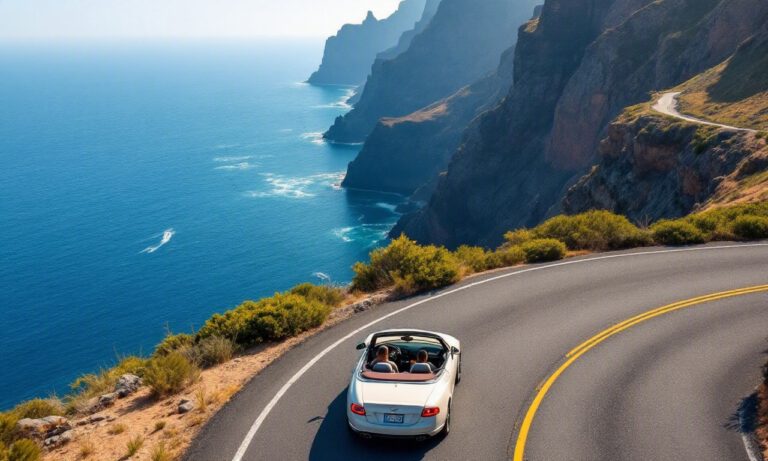
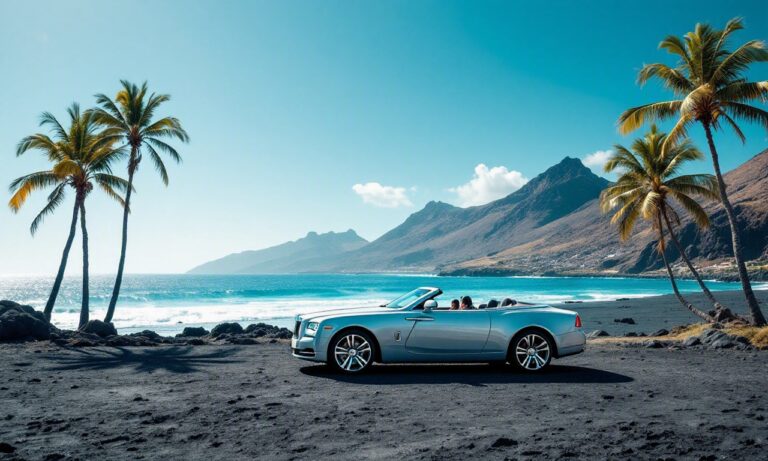
There is a stretch of the south Tenerife coast that was made for an open top. It begins in the buzz of Playa de las Americas, slides north through the calm, palm-lined avenues of Costa Adeje, and ends at a string of fishing-village tables in La Caleta, just as the sun drops behind the silhouette of La Gomera. It is short. It is easy. And with the roof down, you do not watch the view here, you are inside it: the salt on your arms, the warm light on the dashboard, the smell of the sea folding over the windscreen at every roundabout.
This is the gentlest great drive on the island, a relaxed coastal cruise you can do in an afternoon and remember for years. No mountain switchbacks, no white knuckles, no need to be a confident driver. Just a smooth ribbon of road along the water, a sunset that turns the whole sky copper, and dinner with your feet almost in the Atlantic. Here is how to do the south Tenerife coastal drive from Playa de las Americas to La Caleta properly, and why a convertible is the entire point.
The drive: why this is the easiest open-top route in the south
Most of Tenerife’s famous routes ask something of you. Teide makes you climb 2,000 metres of hairpins before sunrise. Punta de Teno threads a single-lane cliff road into the far northwest. They are magnificent, and they are not where you start. This one is. The Costa Adeje convertible run is barely more than ten kilometres door to door, almost entirely flat, on wide, well-kept resort roads with gentle roundabouts instead of blind bends. You can take it slowly, you can stop whenever a beach tempts you, and you can do the whole thing in first gear of your enthusiasm and still feel like you stole the best afternoon of the holiday.
That ease is exactly what makes it special with the top down. When you are not fighting the road, you actually notice things: the way the Atlantic changes from teal to deep blue as the afternoon ages, the avenue of Canary palms along the Costa Adeje seafront, the white hotels giving way to low fishermen’s houses as you reach La Caleta. It is a first-timer’s dream and a romantic’s cliche in the best possible way.
The route, step by step
You do not need a printed map for the Playa de las Americas to La Caleta drive, but knowing the rhythm of it helps you decide where to pause.
1. Start in Playa de las Americas
Drop the roof while you are still parked, sunglasses on, and pull out along the coastal avenue heading north. Las Americas is the loud, lively heart of the south, all promenade cafes and surf beaches. Let it be your warm-up: a few roundabouts to get the feel of the car, the sea always on your left.
2. Glide through Costa Adeje
Within minutes the mood softens. Costa Adeje is the polished, palm-shaded neighbour: manicured avenues, the grand hotels around Playa del Duque, and that long, walkable seafront promenade. This is the heart of the drive. Keep the pace slow, follow the coast, and let the avenue of palms do its work. If you only stop once, stop here.
3. Pass Playa de la Enramada and the headland
As Costa Adeje thins out, the road rises onto a low, open headland of black-sand beaches and volcanic rock. Playa de la Enramada sits here, wilder and quieter than the resort beaches behind you, with the wind off the water and an uninterrupted view west to the horizon. This is your first proper open-top moment, nothing between you and the Atlantic.
4. Arrive in La Caleta
Just beyond the headland the road dips into La Caleta, a tiny former fishing village that has quietly become one of the south’s best places to eat. Whitewashed houses, a rocky little cove, boats pulled up on the slip, and a row of seafood restaurants that look straight out to sea. Park the car, take a breath, and time the rest of the evening around the sunset.
Best time to go: chasing golden hour
Do this drive in the late afternoon. The whole route faces west and southwest, which means that for the last hour before sunset the light comes in low and gold, straight across the water and straight onto your faces. It is the single best reason to have the roof down. On the horizon sits La Gomera, the neighbouring island, a blue-grey pyramid that the sinking sun lights up like a paper lantern before it slips behind it.
A simple plan that never fails: leave Playa de las Americas around ninety minutes before sunset. That gives you an unhurried cruise, time to stop at Playa del Duque or la Enramada for a swim, and a relaxed arrival in La Caleta with the sky already turning. Then dinner runs straight into the blue hour. Sunset times shift through the year, roughly 6 pm in deep winter and close to 9 pm at midsummer, so check the day’s time before you set off.
Golden-hour photography
This route is gentle on the driver and generous to the camera. A few things worth knowing:
- Shoot toward the sun for warm, glowing silhouettes of the car against the sea, or with the sun behind you for that copper light on faces and chrome.
- The promenade at Playa del Duque and the rocks at La Enramada are the cleanest foregrounds, palm avenues, black sand and open water with La Gomera behind.
- The roof-down profile shot works best when the car is parked side-on to the sunset, not moving, please keep the camera for passengers and stops only.
- Stay ten to fifteen minutes after the sun is gone. The afterglow over La Gomera is often better than the sunset itself.
Which car for this drive
The honest answer is that any open top makes this route magic, but a convertible is non-negotiable. The entire experience, the light, the sea air, the sunset overhead, only exists with the roof down. A hardtop hatchback drives the same road and feels like a different, lesser day.
Because this is an easy, slow, scenic cruise rather than a performance drive, you have freedom to choose by mood. A classic cabriolet is the timeless pick, relaxed, comfortable, made for cruising the coast at golden hour. If you want a little more theatre and a soundtrack to match the sunset, a sports convertible turns heads on the Costa Adeje seafront. And if you prefer to glide through the resort in near silence, an electric or hybrid car keeps the only sound the wind and the waves. You can see the full open-top range on the cabrio collection page.
Where to stop, swim and dine
The beauty of such a short route is that you can stop as often as you like and still make sunset. Three stops do it justice.
Playa del Duque, the elegant swim
Backed by the smartest hotels in Costa Adeje, Playa del Duque has soft golden sand, calm water and a polished promenade lined with cafes. It is the place for an early-afternoon swim and a coffee before the light turns. Calm, clean and easy, exactly the tone of this drive.
Playa de la Enramada, the wild one
A short hop further on, La Enramada is the opposite mood: black volcanic sand, open sky, and a horizon with nothing on it but La Gomera. Fewer crowds, more wind, more drama. This is the spot to feel the raw side of the south coast and to take the best open-top photo of the day.
La Caleta, dinner by the sea
La Caleta is the reward. This little village trades almost entirely in seafood, and the restaurants along the front serve the day’s catch with the Atlantic an arm’s length away. Order fresh local fish, perhaps a plate of grilled prawns, a bottle of Tenerife white from the volcanic vineyards inland, and watch the colour drain out of the sky over La Gomera. Tables on the water fill up fast at sunset, so it is worth booking ahead in high season, or arriving early to claim one.
Practical tips and parking
- Parking in La Caleta. The village is small and evening spaces are limited. There is a sizeable free car park on the edge of La Caleta, a two-minute walk from the restaurants, aim for that rather than the narrow village lanes. Arrive a touch early at sunset and you will park easily.
- Parking along Costa Adeje. Playa del Duque and the main beaches have paid underground car parks and some free street parking that fills quickly. For a short swim stop, the beach car parks are simplest.
- Sun protection. Roof down for two hours of low sun means real exposure. Sunscreen, a hat and a light layer for after dark, the breeze cools fast once the sun is gone.
- Secure loose items. An open cabin and coastal wind do not mix with loose scarves, maps or hats. Tuck everything into the glovebox or a bag before you set off.
- Drive relaxed. Resort roads mean pedestrians, cyclists and other holidaymakers. The whole point here is slow and scenic, there is no hurry, and no view is improved by rushing.
How to get the car
Here is the easy part. You do not need to collect anything from a depot or queue at the airport. Mandry Cabrio delivers your convertible straight to your hotel or apartment in the south, Playa de las Americas, Costa Adeje, La Caleta and everywhere between, so your open-top afternoon can begin the moment you walk out the door. Nothing is charged when you book: you simply pay on pickup. And our team is on WhatsApp throughout, so if you want a tip on the day’s sunset time or a restaurant in La Caleta, just ask.
Pick your perfect open top from our full fleet, tell us your hotel, and we will have it waiting. To rent a convertible in Tenerife for this drive and have it delivered with no card needed to book, message us on WhatsApp and we will sort the rest.
Once you have caught this sunset, you will want the others. When you are ready for more, climb above the clouds on the Teide sunrise route, chase the wild light of the northwest on the Punta de Teno sunset drive, or browse the island’s most romantic wedding car locations for the day you want to remember forever.