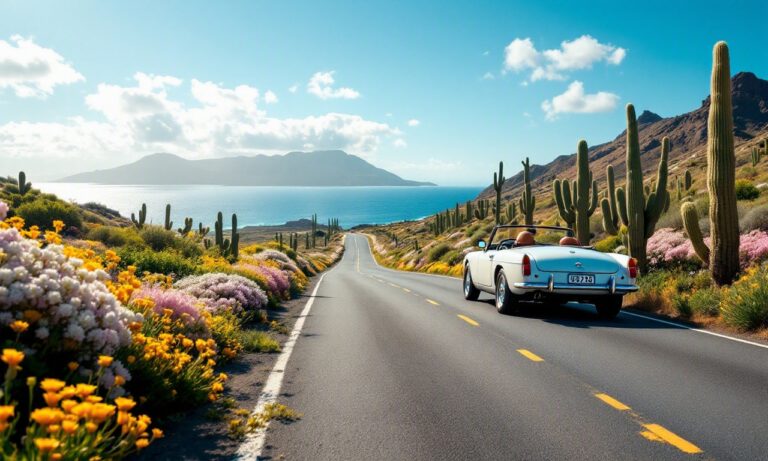
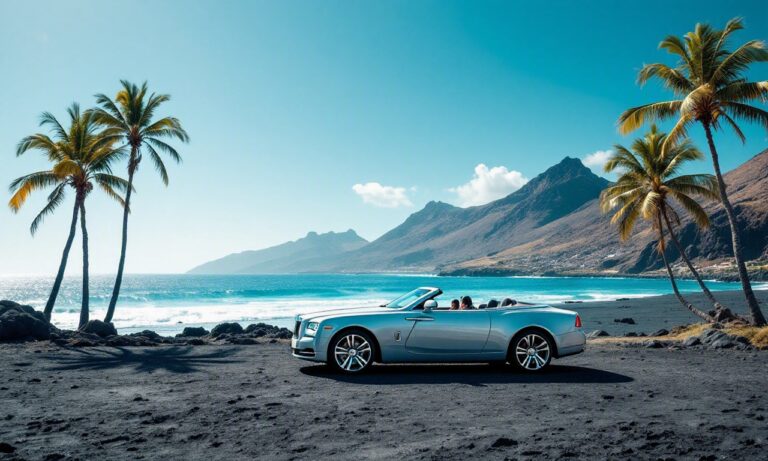
On the west coast of Tenerife the land stops abruptly. The Acantilados de los Gigantes rise straight out of the Atlantic in a wall of dark basalt several hundred metres high, running for kilometres with no beach beneath them. The coastal road that approaches from the south is one of the island’s great open-top drives, and the cliffs themselves are best understood from two places: the road above, and the water below.
The cliffs, from the road and the water
The scale takes a moment to register. From the town of Los Gigantes the cliffs fill the northern view completely, and because there is nothing built on them and nothing at their base, there is no reference point to judge them against. Boats passing beneath look like details. The rock is dark, close to vertical, and the water at the foot of it is deep almost immediately.
The approach by road matters as much as the arrival. Coming up the coast from Playa de la Arena and Puerto de Santiago, the cliffs appear gradually, first as a headland and then as a wall, and the road climbs enough to keep changing your angle on them. Late afternoon is the time to do it: the face points roughly west, so it catches warm light at the end of the day rather than sitting in its own shadow, as it does all morning.
Beyond the town the road continues north and inland towards Tamaimo and, eventually, the Teno massif and Masca. This is worth knowing when planning: the cliffs pair naturally with a mountain drive, and many people combine them into a single day, taking the coast in one direction and the mountains in the other.
The best viewpoints
The Mirador de Archipenque, on the road above the town, gives the classic elevated view along the cliff line with the sea below and, on clear days, La Gomera on the horizon. It is signposted and has parking, and it is the single best stop if you only make one.
Down in the town, the marina and the small harbour give you the view from sea level, looking directly up at the rock. This is the angle that conveys the height, because you have the masts of the boats in the foreground for scale. The short walk out along the harbour arm is worth doing.
For a different perspective again, the road climbing north out of the town towards Tamaimo has several informal pull-outs where the whole coastline opens up behind you. These are less visited than the main mirador and better at sunset. Park properly, well off the carriageway, since this is a working road with buses and delivery traffic.
Boat trips and the marine reserve
Seeing the cliffs from the water is a genuinely different experience, and boats leave from the marina in Los Gigantes throughout the day. Trips range from short cliff-line excursions to half-day sailings that continue north towards the Teno coast, and most include time to swim from the boat in water that is startlingly clear.
This stretch of coast forms part of a protected marine area, and it is one of the more reliable places in Europe to see cetaceans. Pilot whales and bottlenose dolphins are resident in the deep water off this coast rather than seasonal visitors, which is why sightings are so common. Choose an operator that keeps a respectful distance and works to the local guidelines; the good ones are explicit about it, and the experience is better for it.
Book ahead in high season, take more sun protection than you think you need, and remember that the Atlantic gets livelier in the afternoon as the wind builds. Morning departures are generally calmer, which matters if anyone in the party is prone to seasickness.
Where to eat and park
Los Gigantes is built on a steep slope, and parking is the main practical challenge. Spaces near the marina fill early and the streets are narrow and heavily inclined. Arrive in the morning or later in the afternoon rather than at midday, be prepared to park higher up and walk down, and check signage carefully before leaving the car.
For eating, the terraces around the marina have the view, and you pay for it. Puerto de Santiago, immediately south and effectively the same town, has more local places at more sensible prices. Further south again, Playa de la Arena has a good black-sand beach and a seafront that makes an easy lunch stop before or after the cliffs.
A closing note on the open roof. The cliffs create their own wind conditions, and the exposed sections of road above the town can be gusty even on a calm day elsewhere on the coast. Secure anything loose in the cabin before you set off, and if the wind is genuinely strong, put the roof up for the exposed kilometres and drop it again in the town. The view does not require an open car, but it is considerably better with one.